by Neville Ladduwahetty
According to the History of the National Physical Planning Department, the “Anuradhapura Conservation Ordinance, established in 1942, can be considered as the first legal cover presented for the preparation and implementation of plans for any identified area within Sri Lanka; it is probably the first legislation to protect a historic site in the world. Architect/Planner Oliver Weerasinghe who was entrusted with the preparation of the Preservation Plan was appointed as the first Government Town Planner in the Department of Town and Country Planning that was established by the Town and Country Planning Ordinance No. 13 of 1946
The first task of the department was to finalise the Anuradhapura Preservation Plan. The Plan consisted of two parts, the Sacred Area and the New Town”. In 1949 the Government of Ceylon launched the Anuradhapura Preservation Plan with the guidance of Oliver Weerasinghe to protect the ancient ruins by relocating administrative functions and buildings to a separate New town.”
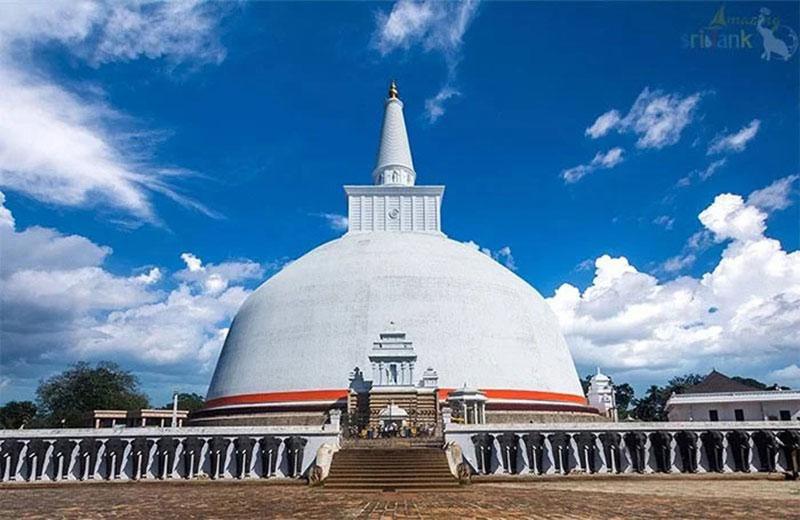
“The Sacred City incorporates Eight Sacred Sites known as the Atamasthaana. They are: Jaya Sri Maha Bodhi, Ruwanwliseya, Tuparamaya, Abhayagiriya, Jetavanaramaya, Mirisawetiya, Lankaramaya and Lovamahapaya”. (Sunday Times, November 8, 2026)
Although the Sacred part of the City of Anuradhapura was separated from the New Town, the Regulatory work associated with Preservation and Restoration was within the Department of Town and Country Planning during Colonial Administrations. Furthermore, notwithstanding the fact that the Sacred City was full of Archaeological Artifacts “associated with living traditions of universal significance, specifically serving as the cradle of Theravada Buddhism” (UNESCO, the statutory institution continued to be the Department of Town and Country Planning.
This status remained unchained from 1946 to 1998 i.e. 52 years, until the Antiquities (Amendment) Act, No. 24 of 1998 which states: “An Ordinance to provide for the better preservation of the antiquities of Sri Lanka and of sites and buildings of historical or archaeological importance in Sri Lanka”. Paragraph 40 (g) of this Ordinance states: “the Director General of Archaeological is Empowered–to conduct archaeological impact assessment of areas that may be affected by development, industrial or other projects proposed by the government or any person and implement any mitigatory measures that may be required”.
As the title of the Act No. 24 of 1998 states: “the Ordinance was intended to “better preservation of antiquities” and concludes that it took 52 years to realise it despite the presence of Archaeologist of world repute while UNESCO’s declaration cited below was in 982 – 16 years earlier than Sri Lanka.
The declaration of Anuradhapura was a World Heritage Site and its justification for doing so was:
“This was officially inscribed as a UNESCO World Heritage Site in 1982 during the 6th Session of the World Heritage Committee.
The primary statutory documentation declaring its inscription is the official under the decision 06COM VIII.20 (Nominations to the World Heritage List).
Core Justification & Criteria
The inscription was heavily based on the evaluation conducted by the International Council on Monuments and Sites (ICOMOS). The site was admitted to the World Heritage List under three specific cultural criteria:
· Criterion (ii): The sacred city exerted a major, long-term influence on the development of local architecture over several centuries.
· Criterion (iii): It stands as a unique testimonial to the ancient Ceylonese civilisation, having served as a prominent religious and political capital for over 1,300 years.
· Criterion (vi): The city is directly and tangibly associated with living traditions of universal significance, specifically serving as the cradle of Theravada Buddhism and hosting the , a sacred fig tree grown from a cutting of the historical Buddha’s tree”
THE CONSTITUTION of 1977
As for the Sacred City of Anuradhapura, the status quo remained unchanged until the Constitution of 1977 introduced Article 9.
Article 9 states: “The Republic of Sri Lanka shall give to Buddhism the foremost place and accordingly it shall be the duty of the State to protect and sponsor the Buddha Sasana, while assuring to all religions the rights granted by Articles 10 and 14 (1) (e)”.
Cited below are Judgments from the Supreme Court as to what constitutes the Buddha Sasana:
“In the Antiquities Amendment Bill, the Supreme Court, in its determination, observed: The expression Buddha Sasana is wider than Buddhism and includes the entire establishment, together with objects and places of religious practices and worship of Buddhists”.
In Re the Thirteenth Amendment to the Constitution and the Provincial Councils Bill, 1987 2 Sri Lanka LR 312, Wanasundera J, referring to the term Buddha Sasana, said that it was “a compendious term encompassing all ancient, historic and sacred objects and places which have from ancient times been associated with the religious practices and worship of Sinhala Buddhists”.
It is clear that the Buddha Sasana is not confined to matters of ritual or practice, but includes the substance of Buddhist teachings. This is borne out clearly in other judgments of the Supreme Court.
An explicit example is the determination of the Supreme Court in the Ayurveda Amendment Bill, SCSD, numbers 22-35/2023, where the Court declared: “We hold that Buddha Sasana in Article 9 of the Constitution includes the dhamma, principles and teachings of Buddhism, including in particular recognized and undisputed codifications of the teachings of Lord Buddha”.
Buddha Sasana (Chapter 1) as Defined by the Presidential Commission of 2002
The Commission recommends the following definition to the term Buddha Sasana”.
12.1 Buddha Sasana is defined as the Buddha, the nine super-mundane (navalokuttara) Dhamma, the Sangha, the Buddhist temples (viharas) with their ancillary structures, forest hermitages (aranya senasana) and meditation centres, Bo trees, stupas, image houses, relic chambers, dhamma books and libraries, designated buildings for performance of vinaya acts by the sangha (uposathagara), fields, gardens and properties belonging to the Buddhist temples, Buddhist education, devalas, nuns and nunneries, the laity who had taken refuge in the Triple Gem, Buddhist literature, culture and civilisation, Buddhist festivals and processions (peraharas), Buddhist customs and traditions, Buddhist principles and values and all that are required for its perpetuity .
12.2 It shall be the responsibility of the State to protect and foster the Buddha Sasana in terms of Chapter II of the Constitution of the Democratic Socialist Republic of Sri Lanka. The Government, all institutions and the citizens are bound by the constitution of that country. Therefore, it is inferred by the Commission that the constitutional obligation accorded by the Constitution of Sri Lanka to give to Buddhism the foremost place and accordingly to protect and foster the Buddha Sasana devolves on the Government of Sri Lanka, all state institutions, other organizations, and all its citizens. (1.26)
CONCLUSION
Having set up the Anuradhapura Conservation Ordinance in 1942, as the first legal instrument presented for the preparation and implementation of plans, the Government’s first task was for the Department of Town and Country Planning to establish the Town and Country Planning Ordinance No. 13 of 1946. The first task of the Department was to finalise the Anuradhapura Preservation Plan, which consisted of two parts, the Sacred Area and the New Town in order to protect the ancient ruins by relocating administrative functions and buildings to a separate New town. In 1949 the Government of Ceylon launched the Anuradhapura Preservation Plan based on the fundamental concept that the City of Anuradhapura was to consist of a Sacred Area that would be separate from the New Town.
Notwithstanding this division, development work relating to both the Sacred Area and the New Town were undertaken by the Department of Town and Country Planning in the absence of any other implementing Agency. This structural arrangement meant that the Archaeological Department had NO official involvement in the preservation and restoration of the sacred part of the City that UNESCO inscribed as a World Heritage Site in 1982 and named it the Sacred City of Anuradhapura.
This sorry state of affairs continued from 1946 until 1998 i.e. 52 Years, despite the fact that Article 9 of the 1977 Constitution requires the “State to protect and foster the Buddha Sasane, when the ANTIQUITIES (AMENDMENT) ACT, No. 24 OF 1998 was introduced. Paragraph 40 (g) of this Amendment requires the Director General to undertake “archaeological impact assessment” of areas that may be affected by development”. Although it is reported that the Archaeological Department had participated in the Development of the National Physical Planning Department’s Plan, up to now, no Archaeological Impact Assessment has been conducted, nor does the Public have access to the Plan despite claims of transparency.
For the status quo to continue notwithstanding that the Sacred City of Anuradhapura did not have the input from the Archaeological Department from 1946 to 1998 i.e. 52 years, and despite Article 9 of the 1977 Constitution stating that “the State to protect and foster the Buddha Sasana” and for UNESCO to inscribe the Sacred City as a World Heritage Site in 1982 is a serious lapse on the part of past governments.
It is imperative that the incumbent government review the structural arrangements contemplated and acknowledge that THE ONLY LEGITIMATE INSTITUTION TO “FOSTER AND PROTECT THE BUDDHA SASANA” IS THE MINISTRY OF BUDDHASASANA, a dedicated institution mandated to give “Buddhism the foremost place”.
Furthermore, UNESCO has described Anuradhapura as the “birthplace of Theravada Buddhism”. Therefore, all resources required for development within the Sacred City should be borne ONLY by the people of Sri Lanka, without foreign inputs of any kind, irrespective of their source.
Expecting advisory bodies to undertake the task of fostering and protecting the Buddha Sasana is also foolhardy. The Sacred City is a living heritage, whereas advisory bodies are transient entities and, as such, lack enduring accountability.